

 Çerez Tercihleri
Tarama deneyiminizi geliştirmek, kişiselleştirilmiş içerik sunmak ve trafiğimizi analiz etmek için çerezler kullanıyoruz. Lütfen aşağıdan tercihlerinizi seçin.
When Beard Donor May Be Considered
- Hair Transplantation Is More Than a Graft Number
- Understanding Hair Transplantation
- When Beard Donor May Be Considered
When Beard Donor May Be Considered
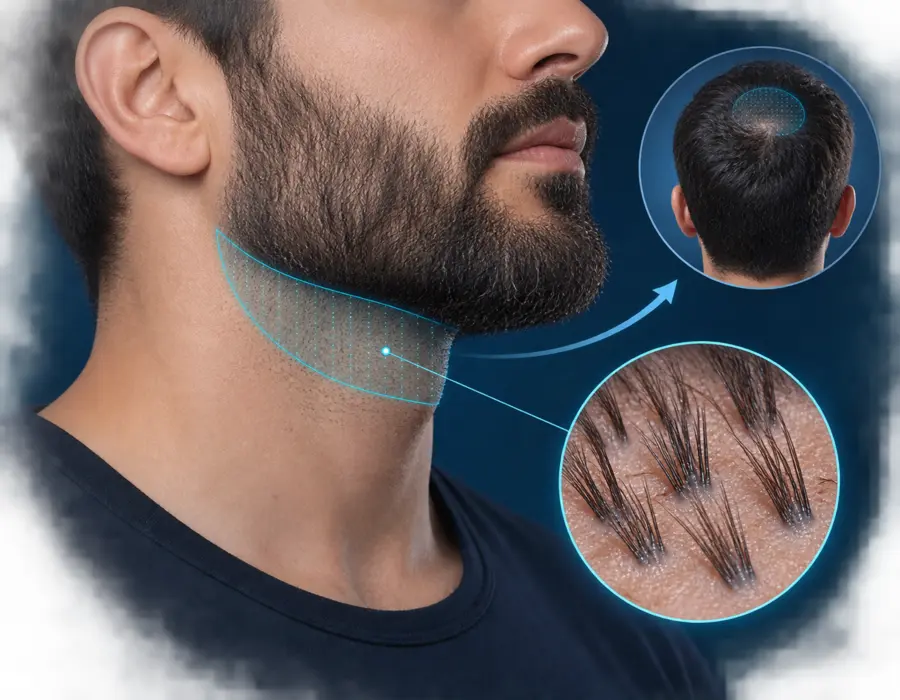
Beard Hair as a Supplementary Donor Source
The scalp is generally the primary donor source in hair transplantation because scalp follicles usually provide the closest match for scalp recipient areas. In selected cases, however, the available scalp donor supply may not adequately support the proposed coverage.
Beard hair may then be evaluated as an additional donor resource. This does not mean that it is interchangeable with scalp hair or suitable for every patient. Its use requires separate assessment and should form part of an individualized, long-term donor strategy.
When Might Beard Donor Be Discussed?
A beard donor assessment may be considered when:
The scalp donor supply is limited in relation to the proposed recipient area
Previous procedures have reduced the remaining scalp donor capacity
Additional follicular units may be needed for selected central or crown regions
Coarser hair could contribute useful visual coverage within an appropriately designed mixed-graft plan
The beard has sufficient density and distribution to permit conservative harvesting
The expected change in the beard donor region is acceptable to the patient
These circumstances do not establish suitability on their own. The proposed recipient area, remaining scalp donor supply, progression of hair loss and long-term priorities must still be considered together.
Beard Hair Is Not the Same as Scalp Hair
Beard and scalp follicles may differ in:
Hair-shaft calibre
Curl or wave
Colour
Growth direction
Length of the growth cycle
Follicular-unit composition
Visual behaviour after transplantation
Published observations suggest that transplanted beard hair can retain characteristics such as its original colour, curl and calibre. Beard hair should therefore not be expected to transform into scalp hair after transplantation.
This difference can be useful in some regions and visually unsuitable in others.
Why Recipient-Area Selection Matters
Coarse beard hair may provide visual bulk when incorporated into selected central or crown regions. It may also be combined with scalp grafts so that different hair characteristics are distributed deliberately rather than concentrated in one conspicuous location.
The delicate leading edge of a frontal hairline usually requires finer hairs and subtle transitions. Coarse or strongly contrasting beard grafts may be visually noticeable in this position.
This does not create an absolute rule for every patient, but it demonstrates why beard grafts should not be placed according to graft availability alone. Hair calibre, curl, colour contrast and the intended visual transition must guide their use.
Assessing the Beard Donor Area
The presence of a beard does not automatically mean that it provides an appropriate donor supply. Assessment may include:
Density in different beard zones
Distribution of follicular units
Hair-shaft calibre
Curl and growth direction
Colour compatibility with scalp hair
The angle at which the hairs emerge from the skin
Skin condition and previous scarring
The patient’s usual shaving style
The importance of retaining a particular beard shape
The potential visibility of reduced density or small scars
The area beneath the jaw may sometimes be considered because changes there can be less visible in ordinary facial views. Its suitability and boundaries nevertheless vary between individuals.
Preserving the Appearance of the Beard
The beard donor region is also a limited biological resource. Extraction should not be concentrated simply because the area is less visible than the face or scalp.
A conservative plan should consider how follicular units are distributed and how the region may appear when:
Clean-shaven
Trimmed closely
Viewed from below
Exposed to strong lighting
Examined after healing
An extraction pattern that is acceptable beneath a longer beard may become more noticeable when the patient later chooses a shorter style.
The patient’s future facial-hair preferences should therefore be discussed before planning.
Technical Differences Require Attention
Beard follicles may emerge at changing and sometimes very acute angles. Their depth, direction and surrounding tissue characteristics can differ from scalp follicles.
Harvesting may consequently require specific technical experience and continuous adjustment rather than simply applying the same approach used on the scalp.
FUE does not produce a linear scar, but it is not scar-free. Every excision creates a small healing site. The number, spacing and distribution of these sites, together with individual skin and healing characteristics, can affect their eventual visibility.
Possible Limitations and Risks
Potential considerations associated with beard donor harvesting include:
Limited available follicular-unit numbers
Uneven beard density
Visible reduction in density
Small punctate scars or colour changes
Folliculitis or temporary skin irritation
Altered sensation during healing
Technical difficulty caused by changing follicular angles
Mismatch between beard and scalp hair characteristics
An appearance that differs from surrounding scalp hair
Reduced options for future beard restoration
These possibilities should be discussed as part of informed medical evaluation. Beard donor harvesting should not be presented as a risk-free way to obtain an unlimited number of additional grafts.
Beard Donor Does Not Correct an Unrealistic Plan
The availability of beard hair should not be used to justify a recipient-area plan that exceeds reasonable donor resources.
Adding another donor source does not remove the need to prioritize areas, plan for progressive hair loss or establish realistic expectations about coverage and density.
In some cases, revising the recipient-area design or reducing the intended coverage may be more appropriate than expanding donor harvesting.
Combining Scalp and Beard Grafts
When scalp and beard grafts are used together, planning may consider:
Which recipient regions are most compatible with each hair type
Whether beard grafts should be dispersed among scalp grafts
Differences in calibre, curl and colour
The visual effect under different hair lengths
Existing hair within the recipient area
The number and quality of available scalp grafts
Possible future hair-loss progression
The aim is not to conceal the origin of each graft through a standard formula. It is to avoid abrupt visual differences and use each donor source in a deliberate manner.
Questions Worth Asking
Before beard donor harvesting is considered, patients may wish to ask:
Why is an additional donor source being proposed?
How was the remaining scalp donor capacity assessed?
Which part of the beard would be evaluated?
How will the normal appearance of the beard be preserved?
Could reduced density be visible when clean-shaven?
How do the beard hairs compare with the scalp hairs in calibre, curl and colour?
In which recipient regions would beard grafts be used?
Will they be mixed with scalp grafts?
Who will plan and perform the harvesting?
What risks, scars and limitations should be considered?
How could the plan affect future scalp or beard options?
Answers should relate to the individual examination rather than a predetermined graft package.
The Central Principle
Beard hair may expand the available donor options in selected patients, but it should be viewed as a supplementary and biologically limited resource.
Its use requires compatibility between the beard donor characteristics, the recipient-area plan and the patient’s long-term priorities. Preserving the appearance of both the scalp and beard donor regions remains part of the same donor-management responsibility.
Suitability cannot be determined from photographs, graft requests or general website information alone. It requires an individualized medical examination and informed discussion.
Educational References
International Society of Hair Restoration Surgery — FUE: What Is It?
International Society of Hair Restoration Surgery — Beard and Mustache Transplant
Use of Body and Beard Donor Hair in Surgical Treatment of Androgenic Alopecia
Development of an Evaluation System to Classify Beard Donor Area for Hair Transplantation
External sources are provided for general educational reference. No affiliation or endorsement is implied.
This content is intended for general educational purposes and does not replace an individualized medical examination, diagnosis or treatment plan.
Diğer Hizmetler

Understanding Scarred Scalp Tissue
Scarred scalp tissue may

Facial Proportions & Hairline Position
Hairline position should
What Matters in Hair Transplantation
Hair transplantation shou

Medical Assessment & Candidacy
Suitability for hair tran

Positioning During Prolonged Procedures
Hair transplantation may

The Role of the Nurse in Telehealth-Based Hair Transplant Follow-Up
Nurse-led telehealth foll

Master’s Thesis Research: Wound Healing and Infection Prevention in Hair Transplantation
This page introduces a pu

Assessing Donor Capacity
Donor capacity cannot be

Balanced Extraction & Homogeneous Distribution
Donor preservation depend
Hairline Shape & Temporal Design
Hairline shape should con

Suitability, Donor Capacity and Staged Planning
Suitability for hair tran

Non-Pharmacological Comfort Support
Comfort during a prolonge

Burn Alopecia: Nursing Care and Psychosocial Support
Burn-related alopecia may
Donor Area Preservation
The donor area is a limit

Understanding FUE and DHI
FUE describes how follicu

Individualized Planning & Natural Hairline Design
Hairline design should be

Graft Numbers, Density & Distribution
A graft count alone does

Natural Irregularity & the Transition Zone
A natural-looking hairlin

Healing, Follow-Up and Realistic Expectations
Healing in scarred scalp
When Beard Donor May Be Considered
Beard hair may be conside

Complications, Patient Safety and Forensic Evaluation
Patient safety in hair tr

Direction, Angle & Density Transitions
Hair does not emerge from
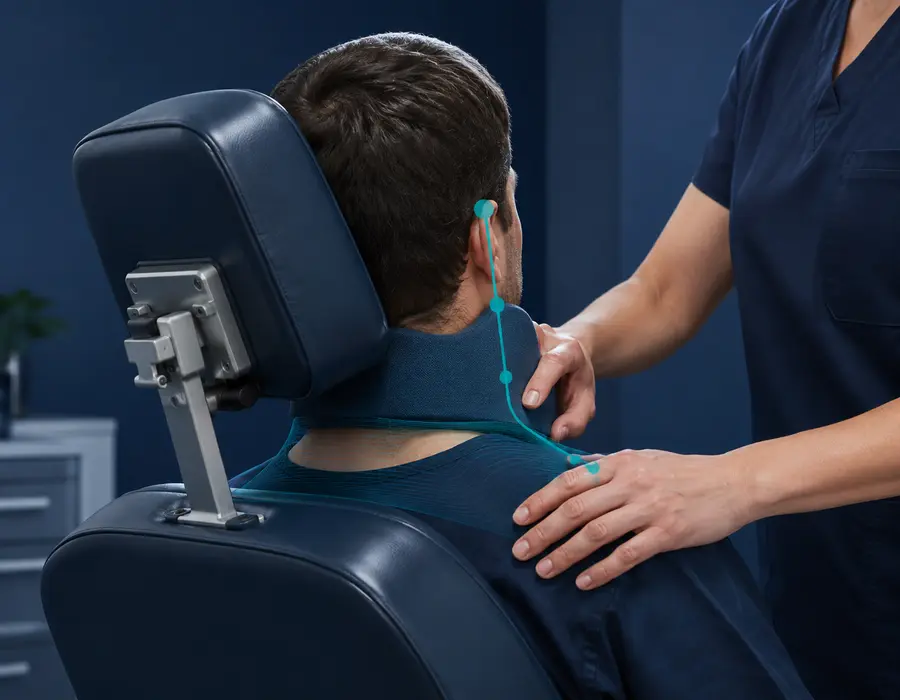
Patient Comfort & Physiotherapy Support
Hair transplantation may

Who Performs Each Stage?
Hair transplantation invo
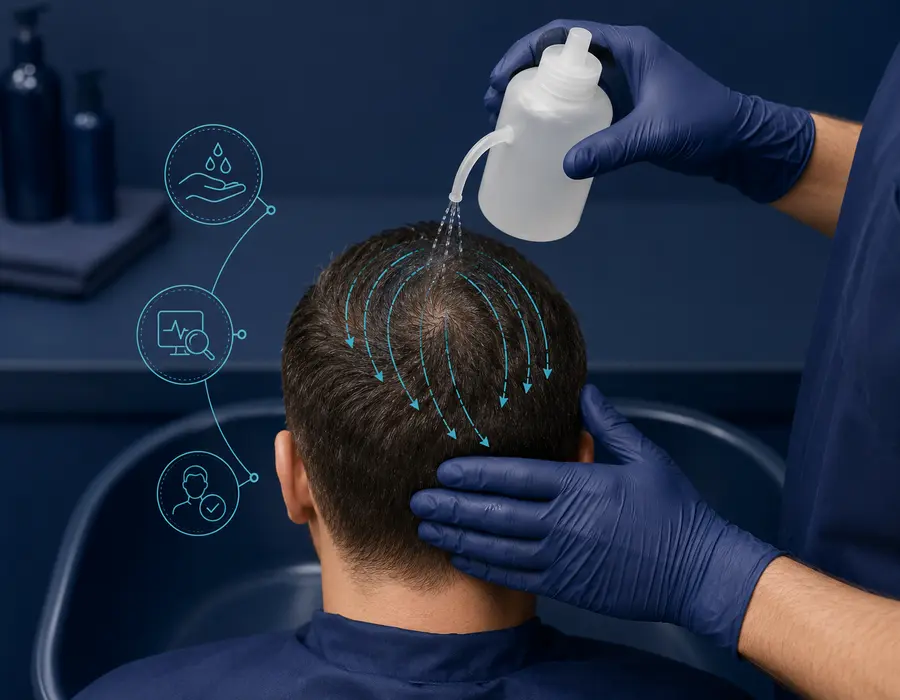
Aftercare & Structured Follow-Up
The period after hair tra

Planning for Women & Different Hair-Loss Patterns
Hair loss in women may pr

Risks, Limitations & Realistic Expectations
Hair transplantation is a
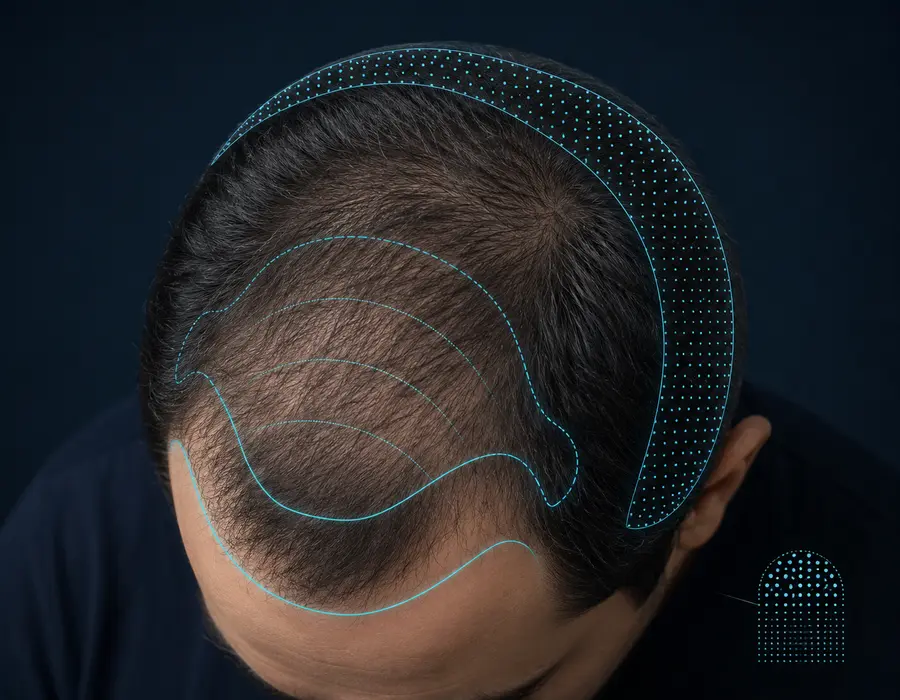
Long-Term Planning & Future Hair Loss
Pattern hair loss may con

Academic Research & Clinical Insights
Easesthetic’s academic fo
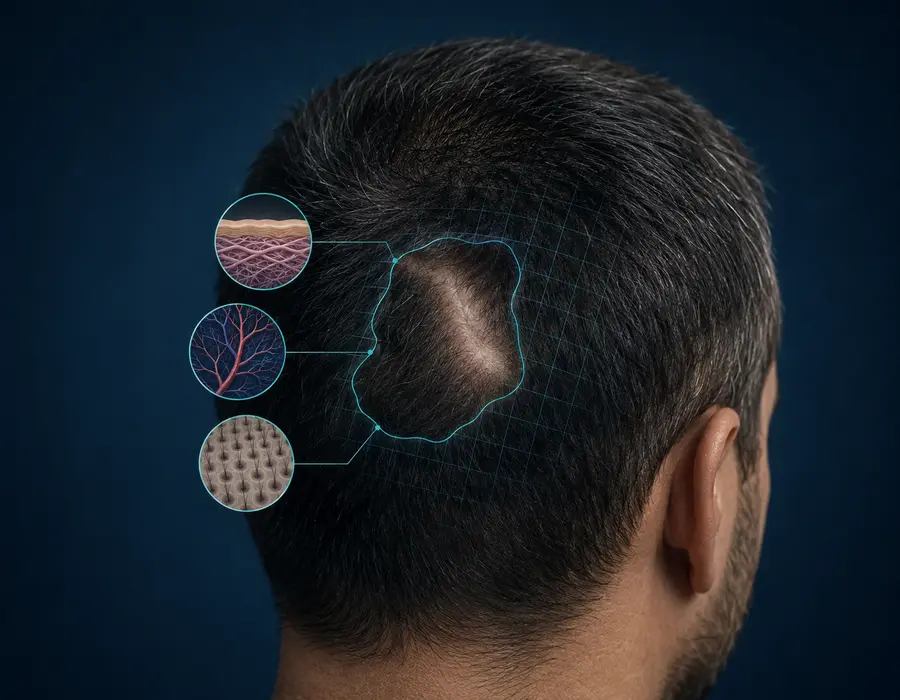
Hair Transplantation in Scarred Tissue
Hair transplantation in s
Frequently Asked Questions